Thursday, June 3, 2021

Big Picture Equation Solving

 Do you have students who get lost while solving a multi-step equations?


Does it appear that they are randomly writing work without understanding what to do when or why?

A different perspective is needed when this happens.  And ... it can be simple!


In the midst of solving a multi-step equation, students can lose track of the goal - to solve for the variable.


What I call "outlining the equation" is one technique I use in this situation.  It doesn't help all kids, but it does help a number of them.  It is a visual that keeps the end goal in sight.  Students begin by making an outline as shown, using DCV.  

Distribute - Combine Like Terms - Get all Variable Terms on One Side


After completing DCV, it looks like this:  


Success!


Friday, May 21, 2021

Algebra: Teach the Instructions

Have you noticed this when teaching Algebra?

I’ve found that when my algebra students are struggling, the cause is often not the math, but the instructions and vocabulary.


For example, if the instructions say “factor the polynomial completely”, students often write solutions as if solving an equation.  As shown below, the student knows how to factor, but goes beyond that due to misunderstanding how an expression and equation are different. 


Often it seems as though students are understanding the material, yet they don’t perform well on assessments.  The example above shows one reason why this may happen.


Here is another example: “Find the zeros to the quadratic function.” or “Find the roots to the quadratic function.”  (Hands go up … “What are zeros?”  or What are roots?”)


The issue is the vocabulary term.  My students may have mastered using the quadratic formula, yet not have a clue how to begin to answer this question.


How can we fix this you ask? 


When you begin the quadratics unit, teach the vocabulary including terms students may see in instructions.  Stress that “answers, solutions, roots, zeros, and x-intercepts” are all synonyms.  Because you know what?  It is confusing!  Although you may not typically consider these to be vocabulary terms for the unit, being familiar with these synonyms is critical to success.


My advice is to make a conscious effort to teach students about not just the algebra, but about the most common errors they are likely to make and how to understand instructions.  You may think it is common sense, but kids don’t have the experience teachers do.  After completing high school and college, we’ve solved so many problems similar to the one above that we naturally do what we should because we have learned.  Students are still learning!

Monday, March 29, 2021

Secondary Math Plans for a Substitute Teacher

There's an old story about a student seeing a teacher in the grocery store.  The student turns to his/her parent, and says, "You mean, teachers shop, too?"

Yes, teachers do the same things and go the same places as other people!

Also, just like people in any profession, a teacher has to miss work occasionally. Perhaps you or a family member get sick?  Maybe you need to attend a funeral?  Do you have professional development or a case conference to attend?  Once in a while you will need a substitute teacher.  
In an effort to make it a bit easier for you when this happens, I have created some sub packs for 6th Grade Math, 7th Grade Math, Pre-Algebra, and Algebra 1.  


These sub packs could be purchased by an individual teacher, a math department, a substitute teacher, or a school.  Pick and choose what lessons to use when. All resources are not only easy to use, but focused on mathematical topics students need to practice.  A day with a substitute teacher should not be a "lost" instructional day!  I've included a number of options in each pack for flexibility.  Activities can be chosen to fit appropriate times of the school year. 

I hope these resources can make missing school a bit easier.  🤞


Sunday, February 7, 2021

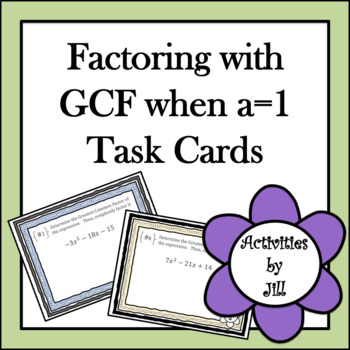
Free Google Slide Factoring Task Cards

These days, so many of us are searching for digital-friendly activities that provide effective practice.  That's why I designed these FREE factoring task cards.  Use the PDF version to create traditional task cards, or the Google Slides link to easily assign them to students digitally. 

Even "in person" instruction involves more technology right now due to social distancing and minimizing contacts.  For certain, traditional task card activities do not lend themselves to distance learning.  However, these Google Slide task cards work great and can be used to change things up a bit. 

Students will completely factor polynomials that have a GCF that is not equal to one.  The binomial or trinomial remaining will have an "a value" of one.  I would consider this activity to be of average difficulty for an Algebra 1 student.

I'd love to hear about your experiences with these task cards!

Saturday, February 6, 2021

 Free Equation Flowchart Notes with Video Example!

You might think that you could just pick up any set of notes and use them.  However, no matter how much you may like the idea of a certain graphic organizer, will it work smoothly for you and your students?  How can you possibly know without trying it out?

I'm giving you the opportunity to see how well this flowchart of "Questions to ask yourself as you solve an equation ..." works!  

The idea is to teach your students to ask the correct questions each time they solve an equation.  That way, they will learn the routine of working through the equation-solving process.

The Equation Flowchart Notes are free in my Teachers Pay Teachers store.  Simply download them if you would like to use them.  I've solved an example using them in the instructional video below.  Whether you like the notes or not, you can make a well informed decision about using the flowchart.  If you use it with your students, let me know how it goes! 

Equation Flowchart in Action!


Tuesday, May 26, 2020

Distance Learning: Which teacher are you?

During this crazy time of distance learning, which teacher are you?


Teacher #1: You're finding yourself frazzled and in desperate need of a crash course in nontraditional learning and technology use.

Teacher #2: You have some experience with eLearning, but are searching for ideas to make your instruction more effective.


Teacher #3: You're a pro at eLearning so this situation is not a problem and you are cool as a cucumber.


Without a doubt, a large portion of the teacher community has been thrown into the deep end of the instructional ocean.  If you are comfortable with distance learning, congratulations!

Whether you identify most with Teacher 1, 2 or 3 likely depends on the school system for which you teach.  Some schools and educators were simply much better prepared for an enforced, extended period of distance learning.

No matter what your personal situation happens to be, I found this Free Student Engagement Toolkit useful.  (Scroll a bit to see the toolkit.)  It offers practical suggestions, strategies, and ideas to assist you in planning instruction.  I think you'll find something helpful regardless of which teacher description best identifies you.

To everyone ... stay healthy and keep a positive attitude!


Sunday, October 13, 2019

FREE Problem Trail for Algebra

It's been a while since I've posted, so here is a new FREE activity I've created for you to use in your algebra classroom.

Problem Trails are great as a way to get students up and moving while keeping a focus on academics.  Enjoy!