Sunday, April 23, 2023

Big Picture: Writing Equations in Slope-Intercept Form

Outlining when trying to write an equation in slope-intercept form can help students stay focused on the goal.

I described this basic idea in my blog post, Big Picture Equation Solving.  However, I think the strategy is even quicker and easier to do with equations in two variables. 


If you have students who are struggling to write an equation in slope-intercept form, try showing them the “big picture”.  A different perspective can make a world of difference in terms of understanding.


Here is how the big picture outline would look: 


The goal is to have the y term on the left, and the x term followed by the constant on the right side (y = mx + b).  I tell students to think more about rearranging the equation than about the mathematics of the task.


Making the outline before solving seems to help many of my students.

I’ve found that it helps them to see step-by-step progress toward accomplishing the goal of getting to slope-intercept form.


The challenge is to get them to make the outline on their own ...


I offer notes in my Teachers Pay Teachers store as well as a variety of products to provide practice on this topic.


Slope-Intercept Form Notes & Practice
Partner Power Slope-Intercept Form
Slope-Intercept Form Pumpkin Puzzle

Tuesday, March 14, 2023

Writing Equations Given Two Points or Slope and One Point

In my experience, this topic is a challenging one for algebra students every year. 


Students try to memorize the rules involved in each situation.  Then, they become frustrated by the amount of information they are trying to remember.


I’ve come to the conclusion that the best approach is to teach this from a problem-solving perspective.  My students have seemed to do better since I have been focusing on this.  They can still memorize the step-by-step rules if that works better for them.


Here’s how I ask students to approach this lesson:

  •    Look at the given information.
  •    Using slope-intercept form (y = mx + b), the information should represent three of the four variables.  Which of the three variables can you substitute numbers for? 
  •    Solve for the remaining variable.
  •    Write the resulting equation in slope-intercept form or standard form.


Remember, this is entirely about how to analyze the given information in order to problem solve.  It is not about following a learned series of steps.  


Try it out and let me know how it goes!


Saturday, April 2, 2022

Anticipating Questions When Teaching

Do you anticipate questions students might ask as you are preparing to present a lesson?


If not, please do.  It helps students so much!


In thirty-seven years of teaching middle school math, I have probably seen every type of mistake and misunderstanding possible.   


I carefully plan the examples I use when giving notes, trying to include problems in which the most common mistakes students are likely to make are demonstrated.


Think back to your own experiences in math classes.  You will probably remember trying to complete assignments that you thought would be easy, only to find out that the problems at the end didn't look like any of the examples.  


Making connections and applying what you have learned is an important skill.  However, students must have an understanding of how to approach solving a problem in order to apply their knowledge.  We don't want them to become so frustrated that they don't attempt the problems.  This isn't an effective lesson.


Be sure to model your thinking both visually and verbally as you explain lessons.  Students need to see and hear the reasoning and thought processes used when solving problems. 


As you discuss a topic in class, here are some things you can say that may draw students' attention to important details:

  • Tell me how we solved the last example.
  • How is this problem similar to others we've solved?
  • How is this problem different from others we've solved?
  • Watch out for this situation ...
  • When you see this, be careful to ...
  • This is a mistake students often make when solving problems like this ...


Thursday, March 3, 2022

Making Connections to Prior Knowledge

Sometimes the little things you say or do as a teacher that can be most helpful to students.  Make connections by linking what students already know to new information.


Activating prior knowledge sounds like a great idea in theory, but do you actually do it?  In your college methods course, it was sure to have been emphasized as a strategy we should all be using.  

I'm not one to create an elaborate introductory lesson leading into a new topic.  You could do that, but how you introduce a topic may be as simple as showing students one example of a problem they may have been expected to solve a year or two earlier, then following up with an example of what the expectation for the current year looks like.

Example #1

If I'm teaching algebraic proportions to my algebra class, I may show them a typical proportion similar to the one below.  Then I would go on to say that the second example is also a proportion.  Therefore, you would solve it the same way, by finding the cross products because cross products in any proportion are always equal.


It can be that simple.

It is tempting to jump right into the new lesson, but just one quick example can turn the light of understanding on for students.  

Example #2

Suppose you are introducing the topic of writing consecutive integer equations.  Rather than immediately telling students how to represent each number, begin with the basics.

Ask, "What are consecutive integers?"

If there is no response, follow up with, "What does it mean to be at school on consecutive days?"

Someone should be able to answer that question and you can use that response to lead into the idea of consecutive integers.

Also, you might ask what is meant by consecutive evens and consecutive odds.

Below, see a sample script of follow up questions to guide students to a better understanding of the problem set up.


You've activated prior knowledge through this simple discussion.

Example #3

When teaching students to solve inequalities, have them solve an equation such as the one shown below.
Next, change the equal sign to an inequality symbol.

Tell students to pretend the greater than or equal to symbol is an equal sign.  As long as they don't flip the inequality over as shown below,


the steps involved in solving the inequality will be just like solving an equation until the last step.

Stress that the only new rule they are learning is to reverse the inequality symbol in the last step if they multiply or divide both sides by a negative.

************************
Students worry about the multiple steps often involved in math problems.  This can cause some of them to shut down right away when beginning a lesson.  Building self-confidence in mathematics is so important!

Linking the topic to a skill or concept that students already understand can build confidence and more readily translate to success.

By clearly establishing at the outset of a lesson, that most of the material is review and only a small part of it is new, you can motivate them to keep working and learning.

Creating a positive atmosphere in your classroom in which students feel encouraged and are developing self-confidence can make a huge difference in their attitudes about the subject in general.  It starts with making connections to prior knowledge.


Sunday, November 14, 2021

Do I really need to teach that? It’s common sense!

What you think is common sense may not be for your students,.  Remember, you are an adult!  While you may think they should just know certain things and that students will make connections using number sense, it is doubtful that they all will.  Teach even what you believe should be common sense.

Wouldn't you be doing your students a disservice by not drawing their attention to those simple connections that could really help them?


Here are three examples based on my experience in the classroom:

Example #1

When graphing linear equations, students don't typically look at equations such as x = 3, y = 8, and 3x + y = 6 and think about what type of line each will form.
So, they just graph a line somewhere on the grid without considering whether the line should be diagonal, horizontal, or vertical.

Fixing this issue can be as simple as having students predict how a line will look before putting pencil to paper.
  • Have them write "horizontal", "vertical" or "diagonal" before graphing.
  • Give a quick check for understanding focused on only this topic.
  • As you work through examples in class, ask students to predict what type of line to expect before graphing.

I think of this as having an understanding of the "big picture".  Others describe it as common sense.


Example #2


Another topic I've noticed that students struggle with is labeling perimeter, area, and volume.  Many of them just don't make the "big picture" connection.  They perform all sorts of contortions to decide how to label an answer.  Some seem to think that the shape determines the labeling.


All they need to know is this:

  • All areas are square units (area, surface area, lateral area, base area).
  • All volumes are cubic units.
  • Anything else is single units (length, base, width, height, perimeter, circumference).

It is not common sense ... teach it!  Every student will not just figure it out.  If so, I would need to be writing this post.  


Example #3


The same goes for positive vs. negative slope.  A positive slope is a line that slants upward from left to right showing an increase.  A negative slope is a line that slants downward from left to right showing a decrease.  Train your students to think about whether the slope will be positive or negative before counting it or graphing a linear equation.


Verbalize the key "big picture" takeaways.


Remember, common sense is not common!

Saturday, October 2, 2021

How to Introduce Negative Exponents

Teaching lessons where patterns are involved is fun!


When I began having students make charts as they were learning about negative integer exponents, it made it so much easier for them to understand rules and concepts.


Let’s face it - to students, it's not logical that negative exponents result in fractions.  Looking at a chart and examining patterns changes promotes understanding.


I begin by having students complete a chart like the one below.


Next, I have them extend the chart as shown.  Then, ask students to study the chart and explain what is happening as they examine the chart which goes from 625 to 125, 125 to 25, and 25 to 5.  Hopefully, they'll recognize that each number is divided by 5 as they work their way down the chart.


I always tell my students that math is all about patterns. 

They love to look for patterns!


We complete the rest of the chart together by continuing with the pattern of dividing by five.  This is a perfect way to review the exponent of zero rule and introduce negative exponents at the same time.

After completing this chart with students, I have them complete a similar one on their own.  Then, I follow that up with a brief class discussion to reinforce the observation that negative exponents result in fractional answers.


Sunday, August 8, 2021

Parentheses when Substituting

Do you sometimes think, "I wish my students could just remember this one thing?"

I'd like mine to remember to use parentheses when substituting into an algebraic expression.  I stress outlining the problem before replacing the variables with numbers.  However, I can't force students to do it.  It can be frustrating because if they do outline the problem first, as shown below, they generally solve it correctly.


One little trick I use when working examples for the class is to highlight each space where a number will be substituted.  Little things like this can help put the focus where it belongs, and is especially helpful to students who are visual learners.


Thursday, June 3, 2021

Big Picture Equation Solving

 Do you have students who get lost while solving a multi-step equations?


Does it appear that they are randomly writing work without understanding what to do when or why?

A different perspective is needed when this happens.  And ... it can be simple!


In the midst of solving a multi-step equation, students can lose track of the goal - to solve for the variable.


What I call "outlining the equation" is one technique I use in this situation.  It doesn't help all kids, but it does help a number of them.  It is a visual that keeps the end goal in sight.  Students begin by making an outline as shown, using DCV.  

Distribute - Combine Like Terms - Get all Variable Terms on One Side


After completing DCV, it looks like this:  


Success!


Friday, May 21, 2021

Algebra: Teach the Instructions

Have you noticed this when teaching Algebra?

I’ve found that when my algebra students are struggling, the cause is often not the math, but the instructions and vocabulary.


For example, if the instructions say “factor the polynomial completely”, students often write solutions as if solving an equation.  As shown below, the student knows how to factor, but goes beyond that due to misunderstanding how an expression and equation are different. 


Often it seems as though students are understanding the material, yet they don’t perform well on assessments.  The example above shows one reason why this may happen.


Here is another example: “Find the zeros to the quadratic function.” or “Find the roots to the quadratic function.”  (Hands go up … “What are zeros?”  or What are roots?”)


The issue is the vocabulary term.  My students may have mastered using the quadratic formula, yet not have a clue how to begin to answer this question.


How can we fix this you ask? 


When you begin the quadratics unit, teach the vocabulary including terms students may see in instructions.  Stress that “answers, solutions, roots, zeros, and x-intercepts” are all synonyms.  Because you know what?  It is confusing!  Although you may not typically consider these to be vocabulary terms for the unit, being familiar with these synonyms is critical to success.


My advice is to make a conscious effort to teach students about not just the algebra, but about the most common errors they are likely to make and how to understand instructions.  You may think it is common sense, but kids don’t have the experience teachers do.  After completing high school and college, we’ve solved so many problems similar to the one above that we naturally do what we should because we have learned.  Students are still learning!

Monday, March 29, 2021

Secondary Math Plans for a Substitute Teacher

There's an old story about a student seeing a teacher in the grocery store.  The student turns to his/her parent, and says, "You mean, teachers shop, too?"

Yes, teachers do the same things and go the same places as other people!

Also, just like people in any profession, a teacher has to miss work occasionally. Perhaps you or a family member get sick?  Maybe you need to attend a funeral?  Do you have professional development or a case conference to attend?  Once in a while you will need a substitute teacher.  
In an effort to make it a bit easier for you when this happens, I have created some sub packs for 6th Grade Math, 7th Grade Math, Pre-Algebra, and Algebra 1.  


These sub packs could be purchased by an individual teacher, a math department, a substitute teacher, or a school.  Pick and choose what lessons to use when. All resources are not only easy to use, but focused on mathematical topics students need to practice.  A day with a substitute teacher should not be a "lost" instructional day!  I've included a number of options in each pack for flexibility.  Activities can be chosen to fit appropriate times of the school year. 

I hope these resources can make missing school a bit easier.  🤞


Sunday, February 7, 2021

Free Google Slide Factoring Task Cards

These days, so many of us are searching for digital-friendly activities that provide effective practice.  That's why I designed these FREE factoring task cards.  Use the PDF version to create traditional task cards, or the Google Slides link to easily assign them to students digitally. 

Even "in person" instruction involves more technology right now due to social distancing and minimizing contacts.  For certain, traditional task card activities do not lend themselves to distance learning.  However, these Google Slide task cards work great and can be used to change things up a bit. 

Students will completely factor polynomials that have a GCF that is not equal to one.  The binomial or trinomial remaining will have an "a value" of one.  I would consider this activity to be of average difficulty for an Algebra 1 student.

I'd love to hear about your experiences with these task cards!

Saturday, February 6, 2021

 Free Equation Flowchart Notes with Video Example!

You might think that you could just pick up any set of notes and use them.  However, no matter how much you may like the idea of a certain graphic organizer, will it work smoothly for you and your students?  How can you possibly know without trying it out?

I'm giving you the opportunity to see how well this flowchart of "Questions to ask yourself as you solve an equation ..." works!  

The idea is to teach your students to ask the correct questions each time they solve an equation.  That way, they will learn the routine of working through the equation-solving process.

The Equation Flowchart Notes are free in my Teachers Pay Teachers store.  Simply download them if you would like to use them.  I've solved an example using them in the instructional video below.  Whether you like the notes or not, you can make a well informed decision about using the flowchart.  If you use it with your students, let me know how it goes! 

Equation Flowchart in Action!


Tuesday, May 26, 2020

Distance Learning: Which teacher are you?

During this crazy time of distance learning, which teacher are you?


Teacher #1: You're finding yourself frazzled and in desperate need of a crash course in nontraditional learning and technology use.

Teacher #2: You have some experience with eLearning, but are searching for ideas to make your instruction more effective.


Teacher #3: You're a pro at eLearning so this situation is not a problem and you are cool as a cucumber.


Without a doubt, a large portion of the teacher community has been thrown into the deep end of the instructional ocean.  If you are comfortable with distance learning, congratulations!

Whether you identify most with Teacher 1, 2 or 3 likely depends on the school system for which you teach.  Some schools and educators were simply much better prepared for an enforced, extended period of distance learning.

No matter what your personal situation happens to be, I found this Free Student Engagement Toolkit useful.  (Scroll a bit to see the toolkit.)  It offers practical suggestions, strategies, and ideas to assist you in planning instruction.  I think you'll find something helpful regardless of which teacher description best identifies you.

To everyone ... stay healthy and keep a positive attitude!


Sunday, October 13, 2019

FREE Problem Trail for Algebra

It's been a while since I've posted, so here is a new FREE activity I've created for you to use in your algebra classroom.

Problem Trails are great as a way to get students up and moving while keeping a focus on academics.  Enjoy!

Tuesday, January 29, 2019

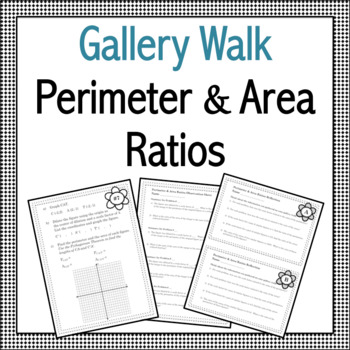
Gallery Walks in Math Class

Have you tried a gallery walk in your math class?

I admit to having heard of them years ago.  However, I've only recently tried one myself.  And ... I'm sold!

Students were forced to observe patterns, pay attention to detail, and draw conclusions.  (This was not easy for them ... and these were high ability students.)

I've designed two gallery walks so far.  I used this one about "Perimeter & Area Ratios" with my pre-algebra students.


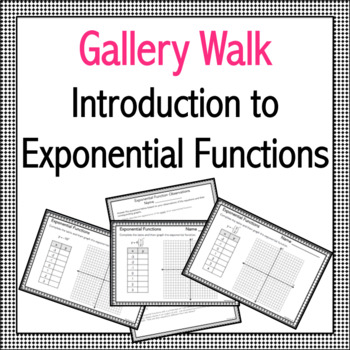
I used this "Introduction to Exponential Functions" gallery walk with my Algebra 1 class.  Since we barely touch on this topic in this course, I tried to keep it relatively simple and used it after giving introductory notes and practice to present the basic information.  (It was appropriate, yet still challenging.)

Multiple, similar problems were posted around the room (or in the hallway).  Students were given recording sheets with questions that required them to focus on certain aspects of the problems.  They had to recognize patterns and similarities, then use them to deduce/synthesis rules.

Here's what I learned from my two experiences:
• If students solve and check the problems a day or two before you plan to do the gallery walk, things will go more smoothly.  
• Of course, it is important that the work is correct.  If not, students will have difficulty observing patterns and identifying similarities.  (A colleague of mine suggested posting the "answer keys" instead of having students solve the problems.  This is a way to save time and be certain that the answers are correct.  Whether or not you have students solve the problems you post for the gallery walk really depends on exactly what you want students to achieve from the activity.)
Lastly, you may look at the gallery walk questions and think that the answers seem relatively obvious.  However, your students will probably not feel the same.  Remember: They are just learning the material.  Also, most students don't practice this type of thinking often so it is challenging for them.

Monday, January 21, 2019

Get to Know Your Students Better


Clipart credit to Thankful in Third
Do you ever wish you knew your students better ... especially if you teach at the secondary level?

As teachers, the list of standards we must cover seems only to grow from year to year.  It can be difficult to find time to connect with students.  How can you learn more about their lives and interests?  

I'm sure we all have "getting to know you" activities in our teacher toolkits.  We use them at the beginning of the school year.  However, when the first week of school is past, do you ever do anything similar again or do you file those materials away for the next school year?


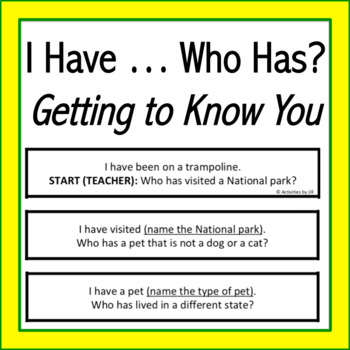
This summer, I created an "I have ... Who has?" game to use at the beginning of the school year.  I was really pleased, and a bit surprised with my students' (8th graders) response.  

Here's the thing ...
Although we enjoyed it, I never expected my students to ask if we could do it again. 

A semester later, when they asked yet again, I did pull out the game.  We enjoyed it just as much and I discovered even more about my students! 

What have I learned?  Getting to know you activities aren't just for the first week of school.    


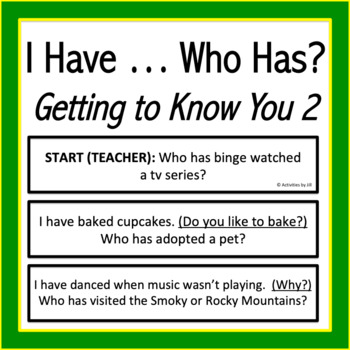
So, I've just finished creating a second version of the game to use before the end of the year.  If you don't use this sort of activity in class, how about trying it during an advisory period or study hall?  There is no prep other than printing the slips and cutting them apart.

Try this or a similar activity and enjoy the benefits of knowing your students better!  Remember, if they enjoy coming to your class and have a positive relationship with you, they will likely be better behaved. 😉